Blog : big bend

The Challenge of the Thing

The Challenge of the Thing

Cameron Cozac finished TPU in 2016. Throughout the race, he was a cheerful, smiling runner. He obviously had a good time, so I contacted him to tell us more about his experience. It is worth mentioning that his beautiful fiancée, Jess, now his wife, was a TPU volunteer that year, and was waiting for him at the finish line each day. That may have contributed to his big smile.


How did you find TPU and how far ahead of the event did you register?

I was looking up routes in Big Bend on Google Earth for an off-road motorcycle trip I was planning with friends. In the process, I found some photos of TPU from the year before. I had never heard of a stage race happening in Big Bend, so I did some research and signed up immediately.

I registered in February for the race in October, so I was committed around 8 months ahead of time.


What was your primary goal for registering?

It was just the challenge of it. I’ve done a lot of hiking and running in Big Bend, and I knew how difficult it would be. When I saw other people had done it already, I thought I’d take a stab at it.


How far ahead of the event did you begin really serious training?

I’m always running, biking, swimming, hiking and doing other stuff outdoors. It’s always nice to have a goal, though; it helps to really motivate me.

But I only really started serious training around 2-3 months before the race. My main goal was to try to get 100 miles a week in. I only managed to do that twice before the race, though.


What did your training look like?

My goal was to get some 100-mile running weeks before the race.

It was always some version of this:

Monday: active non-running day (walk, bike, hike, paddle board, etc.)

Tuesday: 10-mile run

Wednesday: 5 miles easy run with the dog.

Thursday: 3 easy morning miles, then 15-20 miles in the evening.

Friday: marathon minimum: 26 miles

Saturday: marathon minimum: 26 miles.

Sunday: whatever it takes to make it to 100 miles for the week.

Obviously I built up to that gradually, over time. I started at around 20 miles a week.


How did you integrate your training into your work/personal life?

My wife, Jess, works nights as a nurse at Texas Children’s Medical. So normally I would try to get my long runs in overnight while she was working.

I commute 104 miles a day for my job. So sometimes sitting in Houston traffic made it especially difficult to fit a long run into my schedule. I developed a habit of just pulling over to any parking lot I could find off the freeway whenever I hit heavy traffic. I would just run from the random parking lot until traffic died down.

Anytime I had to take my car or motorcycle into the shop, I would just run home and then run back when it was ready to pickup.


Was there anything you would change in your preparation if you were doing TPU over?

I would leave all of the oatmeal I brought at home. A waste of space. It just made me want to vomit after day one.


What do you think of the new 3-stage “mini” TPU?

It’s a nice option for someone who doesn’t feel ready to make the full commitment.


Did TPU meet your expectations? What was the best part of it for you?

Yes. TPU was great. I really enjoyed how small the field of runners was. And the setting was unbelievable.

My favorite part was the Solitario section.

Texas Parks and Wildlife Department


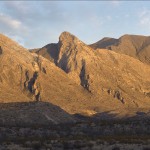
Note: El Solitario is a long-extinct volcano crater. It’s big, about 50 square miles; the caldera is 10 miles across. The Solitario resembles an impact crater (as from a meteor strike) but it is actually a result of complex erosion and later uplift. Geology enthusiasts will enjoy reading more about its formation.


The Singular Geology of El Solitario

A Sense of Place: El Solitario

Geology of the Solitario


TPU athletes will be traversing parts of El Solitario during Stages 1 and 2, and will be part of their horizon view during Stage 5.

Course Maps and Descriptions


Cameron’s wife Jess, leading TPU media coordinator Sheryl through a simulated finish line.

SaveSave

SaveSave

Ethos of the TPU Tribe

Ethos of the TPU Tribe

TPU2017 Finisher Rachael Kadell celebrating at Disney Land.

We’ve all got enough race shirts to supply Goodwill for a decade, so what makes this particular shirt from Trans-Pecos Ultra so special?

It’s not the shirt…it’s the “Tribe”.

Of course, the TPU Tribe exists with or without the shirt, but the shirt is a great reminder of our shared experience.

Once you’ve spent a week in Big Bend, living simple, and unplugged from the outside world, you become connected in many ways to the land and those across the campfire from you. But why?

For ten days, those of us who volunteer and race in TPU experience life with a shared purpose. We sleep side by side in tepee tents, we wake up together at 6am, eat, pack our bags and perform our assigned volunteer duties - or “follow the pink tape” as a racer. The highs and lows of each day are shared with those around us at checkpoints, campsites, and on long bumpy drives.


Leslie Townsend (mom) and Elizabeth Henderson (sister) to RD Chris Herrera (middle).


Those who participate and volunteer year after year at TPU become a tight-knit group who have seen each other’s flaws, forgiven them, and have continued to have faith in each other and TPU, knowing it’s something much larger than just themselves. In so many ways, the TPU Tribe represents family, beginning with the Race Director, Chris Herrera, whose family help him put on the first race, and who come back to volunteer each year.

And pictured in the feature/top image are April, event coordinator, and her husband, “utility player,” Jake McAnally, who’ve been involved since the beginning. These two open their home to so many - from Alpine Cowboys baseball players each summer, to RD Chris who lived with them upon first arrival in Alpine. And for those who don’t know, TPUHQ is actually the McAnally’s house; just go down to the basement and you’ll find blue water containers, tepee tents, and everything in between, like portable toilets (by the way, we don’t use those anymore since we’ve got awesome camp sites with actual toilets and even a pool!)


Alpine local sisters - Elise (racer) and Sarah (volunteer ) Sibley at Tres Papalotes campsite.


Sure enough, every year, we have families in the lineup - brothers, sisters, and several married couples. So It not only feels like family; in many cases, it is family.

And all this happens in one of the most remote and rarely visited locations in the country. Big Bend Ranch State Park is the largest state park in Texas, and offers outdoor recreation for the truly adventurous. The interior roads of the park are not even passable without four-wheel drive. It’s a great big rugged expanse, and when TPU comes in October, we have the place mostly to ourselves. That isolation draws us all closer, racers and volunteers alike. As RD Chris Herrera observes…

“Being outdoors can be one of the most powerful environments for personal discovery”.

TPU2017 racers, best friends, Rachael Kadell & Shelli Sexton from California.


So who is the TPU Tribe?

We are people just like you… hikers, runners, and everything in between - 4×4 enthusiasts, medics, Ironman triathletes, academics, accountants, etc. The life experience among the TPU Tribe is widely varied, almost random, but it makes this event what it is.

Our tribe truly values Big Bend, a place like no other. We love camping under the bright stars, we love how campfires bring out the inner storyteller in us, we love sleeping overnight in Fresno canyon. We love the way the outdoors provides solace from everyday life and how a week in Big Bend gives us time for reflection, to recharge, and how we leave the place a bit more purposeful, more intentional about our lives. It’s an experience we want to share with others, both within the Tribe and in our personal communities outside TPU.

TPU2017 finish with Clay Henry III (goat), Mayor of Lajitas, TX.


Simplicity, humility, and compassion….that’s what TPU and the Tribe represent. And, that’s why this is a shirt so much worth earning.


To join the Tribe, learn about Volunteer spots, see our Course Info & Rules to become a racer, or call the RD, Chris Herrera at 432.294.5284.SaveSave

SaveSave

SaveSave

SaveSave

SaveSave

TPU 2017 Racer Profile – Jess Kolko

TPU 2017 Racer Profile - Jess Kolko

Meet Jess Kolko
Seeking the Wilds of Texas

She’s on the final countdown to the 2017 Trans-Pecos Ultra. A 4-time Ironman finisher, she’s nevertheless impressed with the gravitas of running self-supported in Big Bend. When friends ask what she’s training for, she says that jaws drop at her answer. “It’s just hilarious to watch their faces when I tell them about TPU. I don’t think some people can even grasp the concept of a stage race, let alone a self-supported race in Big Bend Ranch State Park.”

Jess took advantage of TPU’s offer of free coaching upon early registration. She’s had the benefit of Coach Cheryl Tulkoff’s counsel on training, gear, and packing. Cheryl was the first female finisher in the inaugural 2015 TPU, and volunteered on the course in 2016. Aside from the Race Director, Cheryl may have the most complete knowledge of the rigors and pleasures of this self-supported 163-mile behemoth.

Jess used Cheryl’s expertise to review equipment, advise on training and suggest packing strategies. For TPU, racers carry all their gear for the week on their backs from the starting line to the finish, so clever planning is essential.

For months, Jess has had her gear ready and has just been focusing on training and nutrition. Running with a weighted pack in the Texas heat and humidity has highlighted the problem of chafing, which she has solved with tape, as well as the challenge of staying properly fueled when the gut is stressed.

Jess reports that fueling may be her biggest challenge, in spite of the fact that she is a professional nutritionist for Whole Foods Markets. Sometimes, far into a trail day, what she has available just doesn’t seem appealing any more, a problem most trail runners have encountered. But on a 7-day, 165-mile race, a runner can easily bonk on insufficient calories, so Jess has been practicing the fuel strategy diligently.

Her motivation? “I love being outside. I’ve lived in Texas for 10 years and haven’t been out to Big Bend, a place not many people get to see up close and personal. I want the chance to really disconnect from my day-to-day, and gain a stronger connection to the wilds of Texas.”

The wilds of Texas are waiting for you out at Big Bend Ranch. Best of luck, Jess!


“Like” our Facebook page to get race updates during the week of TPU 2017!


SaveSave

SaveSave

Sleeping Bags for Self-Supported Stage Races

Sleeping Bags for Self-Supported Stage Races

“In the Bag”

Nowhere does your equipment dollar buy such a difference as in sleeping bags. You trade dollars for weight. On the high side, you can go incredibly light and small…or pay less and get a heavier bag.

Set a budget range for yourself before you begin looking; that will simplify your decision. For example, if I decide I want the best I can get for under $300; that allows me to rule out the mega-light options on the top and the Girl Scout options on the bottom.

A question you might ask as you choose a price range: will I use this bag again after TPU, and for what purposes? In terms of weather, TPU is light duty; you won’t get rained on and it rarely gets colder than 45° at night. If this bag is only going to see action at TPU, you can get by just fine with a cheaper bag. But if you’re also planning a thru-hike on the Pacific Crest next year or you’re an incurable camper, you’ll be willing to pay more to have a bag that will work in colder climates than Big Bend.

The temperature rating for bags qualifying for TPU is 45° F minimum (7° C). Almost all three-season and summer bags meet that standard. If you don’t see any later cold-season camping in your future, a summer bag might be all you need.

The historical average temperatures for Big Bend Ranch in October range from 45°F at night to 75°F high during the day. (www.myweather2.com). In reality, the high temp each day is usually in the 85°F - 90°F range given the high degree of southern exposure and the night temp is a desert climate so it feels cooler to some. With that all said - it’ll be personal preference but remember you’ll be sleeping inside our teepee tents, which does conserve some warmth at night.

Now… down or synthetic materials? Down is ultralight, compressible (small volume in your pack) and it holds warmth well; on the down side (so to speak)… it clumps up when it gets wet, it’s an animal product and it’s more costly than synthetic.

Synthetic is easier to clean, hypoallergenic, and less expensive, but it is also heavier, bulkier and provides less warmth per ounce. You can read more about the comparisons here.

Now down to the nitty-gritty. After you’ve made your decision about future use of the bag, temperature requirements, materials, and cost range, you can dive into some particular bags.


WAA sleep system / jacket and zip-in half-bag

There are some good choices from Europe, where expedition stage races like Marathon des Sables are more common than in the US and manufacturers design specifically for multi-day stage races. WAA, a French company, offers an innovative system, the Ultra Sleeping Jacket, a two-in-one product, down-filled and weighing in at a total of 24 oz. It’s a down jacket that zips onto a half bag. By day, the bag fits into the pocket of the jacket. Fully compressed, the whole rig measures 9”x 8”x 3”. At $400, it leans toward the high end, but the jacket will likely get good use by any runner, even if the lower bag sees limited use.


Peter Hutchinson Designs (PHD), a British outfit, allows you to custom-build your own bag. This is probably overkill for TPU, but if you have other expeditions in your future, you might take a look. After you choose the base bag rated for temperature, you can add options like a foot zip, mummy hood, fill pattern, and custom length. The cheapest no-frills bag is £276, or about $350. If you are unusually tall, their custom sizes might be worth the price tag.


On the American side, Western Mountaineering’s Everlite down-filled bag packs down to a mere 5”x10”, weighs less than a pound and is rated to 45°. List price is $320, but I saw it on sale for $285. Nice. (But if you like “pretty” in a bag, this one only comes in brown.) The Everlite was the bag of choice for 2016 finishers Eric and Paul Chan.

Sea-to-Summit Spark SP II


Sea-to-Summit makes a great three-season bag, the Spark II, that packs down to the size of a grapefruit. It’s rated to 35° and weighs a pound. It’ll run you around $375.


REI Helio

REI carries some great bags, and you get the extra advantage of in-store advising and getting to touch the product before buying. The REI Helio Down bag sits at the lower end of cost at $140, but it meets the 45° temperature rating, stuffs down to about 9”x7” and weighs 26 oz.

The Marmot Atom (sold by REI) is a down three-season bag rated to 35°, weighing in at 21 oz and costing $289. The Atom’s synthetic cousin would be the Trestles bag, which costs only $100 but weighs nearly 3 pounds.


North Face Aleutian


The North Face Aleutian 40 is a synthetic bag with a light price tag of $100 and a lighter weight at 2 lbs 3 oz. It stuffs down to 9”x16”.


More and more fastpackers are looking at sleeping quilts now, rather than bags. A sleeping quilt is lighter, packs down to a smaller volume, allows more freedom of movement for toss-and-turners and is more versatile than a bag. You can cover your torso while leaving legs free, or vice versa, with no zipper issues, making it more agreeable on warmer nights. Most are available with a drawstring at the bottom to close up for foot warmth, but it’s not draft-proof in truly cold weather. The sleep quilt is an approved option for a race like TPU (so long as it has the drawstring or zip function).

Choices Available from Enlightened Equipment


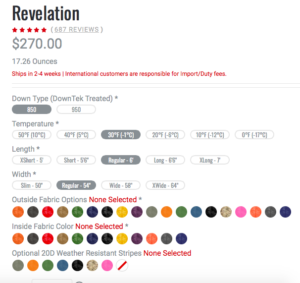
Enlightened Equipment has down and synthetic versions, with about $100 price difference. I like the freedom to choose your own interior and exterior colors, length, width, and temperature rating. The custom choices require 2-4 weeks lead time.


Thermarest Neo XTherm


You’ll probably want a sleep mat, too. You may not need it for warmth insulation, but it’ll make the rocky ground more sleepable. TPU veteran Cheryl Tulkoff uses a Therm A Rest Neo Air Xtherm which will run you about $150. It weighs just less than a pound and is constructed with over 100 cells, which works well on the rocky terrain that is a feature of Big Bend. The Therm A Rest XLite at $130 weighs a half-pound less, but there may a reason for the link to the video “How to Fix a Leaky Sleeping Pad” on the Amazon page. TPU veteran Eric Chan found that the valve on his XLite leaked over time.

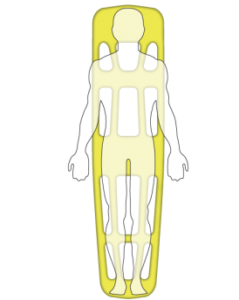
The Klymit Static V is a full-size mat that weighs only 18 oz, costs $55 and is constructed of rugged material that isn’t afraid of rough terrain. Klymit’s Inertia X-Frame takes out bulk and leaves padding only at pressure points (head, shoulders, hips). Pared down to a skeleton, it weighs only 6 oz., stuffs down to the size of a soda can and costs $60 on Amazon.

Klymit Inertia X-Frame

For 3 more ounces and about the same price, you can get the full-length Inertia X-Frame.

There are ever so many more choices; I’m only scratching the surface for simplicity’s sake. You get the idea: the more you’re willing to pay, the lighter you can go.

Check out your local mountain store, countless outdoor websites or your nearest REI retailer.

If the many choices have you bewildered, contact the Race Director, Chris Herrera. If he doesn’t have the answer, he can steer you to someone who does. Reach him at [email protected] or 432.294.5284.


Stage Racing Backpacks

Stage Racing Backpacks

Choosing a pack is a series of trade-offs between utility and weight, with you as the final judge. Below are three important factors to consider as you try on various models.

  • Considering that you will carry it for 163 miles during TPU, your pack may be the most consequential decision you make (after deciding to sign up for this crazy adventure!) The lighter your pack is and the more comfortably it fits to your spine, the more you will enjoy the ride.
  • How does the pack ride? Frame or frame-less? Weight-transferring hip belt or simple webbing straps? Vest front or padded shoulder straps?
  • Size. There is only so small you can go with your pack… you have to be able to carry your sleeping bag, a bare minimum of 14,000 calories of food, incidentals, and water. Past TPU runners have not gone below 20-liter capacity.

Stage racing backpacks: A little more detail…

In a survey of past TPU runners, we found that many packed all the way down to a 20-liter pack. This requires tremendous discipline (or lots of practice), but the advantage of a light, small pack can’t be overemphasized! Bear in mind, however, that if your pack is so full that you have to strap your sleeping bag to the exterior, you’ve just added a bit of bounce to your pack. However, re-packing as you eat some food and complete the 6 stage race can help to overcome this issue.

While everyone’s different, a long-distance rule-of-thumb is that you only carry 10% of your body weight on your back. So a 150-pound man would carry a maximum of 15 pounds. With a week’s food, a sleeping bag, safety gear and the pack itself, this can be a colossally difficult standard, but it’s a good starting point. Food alone might weigh 10-12 pounds at the beginning of the week (more about food in a later post) so finding ways to minimize weight elsewhere is important.

In general, you’re going to want the lightest pack possible that is still functional and offers a certain degree of comfort! The lightest packs have almost no structure: no frame, hip-belt or any way of transferring weight off your shoulders. They are simply bags with straps. Alternatively, you can get an internal frame pack that will transfer up to 70% of the weight to your hips. Something in-between would be a frame-less pack with pods that give form to the pack and thus can transfer some weight off your shoulders.

A hip-belt can relieve your upper body but it adds weight to the pack and can be an additional chafing point, especially with the bounce of running. Frame packs may work better for those planning to mostly hike TPU.

The frame-less packs that mount as vests with wide front panels, hug the body and keep the load closer to your center of gravity, also prevent bouncing and chafing. These bags also have the added feature of water bottle holders in front, making them easier to refill than hydration bladders. Some runners will carry both, with the bladder for backup - but it’s not necessary.

Here are a few representative packs to show you the sort of choices you have:


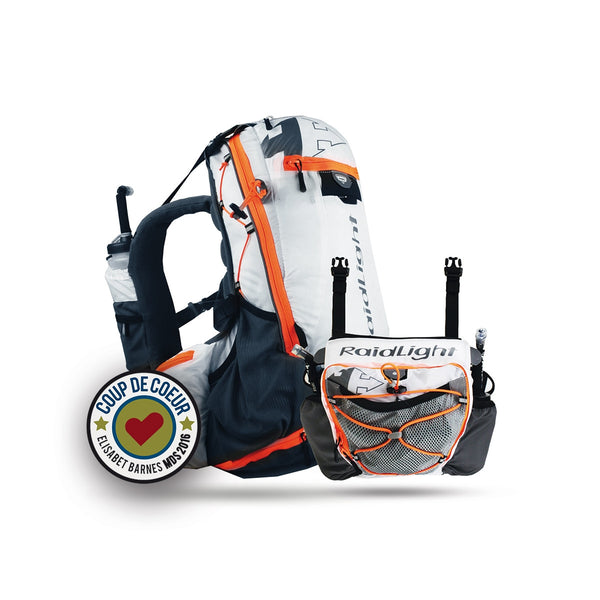
RaidLight Olmo Ultra Raid Desert 20L + 4L Front Pack - Avg price, $179

Especially designed for stage races, the new Ultra Raid Desert 20L bag allows you to take all the necessary equipment with you for races. At 1 lb. 8 oz. ergonomically integrated back and shoulder straps, bottle pockets on vest front, insulated bladder sleeve, multiple small pockets, designed specifically for multi-day events like Trans-Pecos Ultra. This pack remains one of the most common among all TPU participants. Also available in 30L without front pouch.

WAA Ultra Equipment UltraBag 20L+ 4L Pouch (optional) - Avg price, $215

Designed by the experts of ultra-endurance races, the UltraBag was designed and built to meet the needs of the most demanding races like the Marathon des Sables or the most intense multi day FKT attempts. At 1 lb. 5 oz bag only, with optional bottle holders (1.5 oz each) and front pocket (1.5 oz), wide vest-type straps, rectangular shape, 20-liter capacity, designed specifically for Marathon des Sables and now a great option for Trans-Pecos Ultra.

Ultimate Direction Fastpack 20 - Avg price, $115 (Amazon)

Providing all the features and capacity you need and nothing more, the Fastpack 20 is a streamlined pack that will get you there and get it done. At 1 lb. 3 oz. vest front with pockets for water bottles/maps/camera, rear stuff pocket, roll-top closure, water-resistant, 20-liter capacity. This pack was worn by TPU2015 2nd place finisher, and Coach Cheryl Tulkoff.


Osprey Talon 22L - Avg price, $75 (Amazon)

With an updated AirScape™ backpanel, a continuous hipbelt wrap for incredible comfort and a suspension system that stabilized loads for dynamic activities, the Talon 22 remains the most versatile day hiking pack ever built. At 1 lb. 7 oz. External sleeve for easy access to hydration bladder, wide hip belt to transfer some weight off shoulders, mesh back panel for cooling. The Tempest 20 is a female-specific alternative to the Talon. Great for those hiking TPU.

-Author Notes: Sheryl Colmer was a volunteer at TPU2016 and now writes about all things Big Bend, stage racing, and TPU!